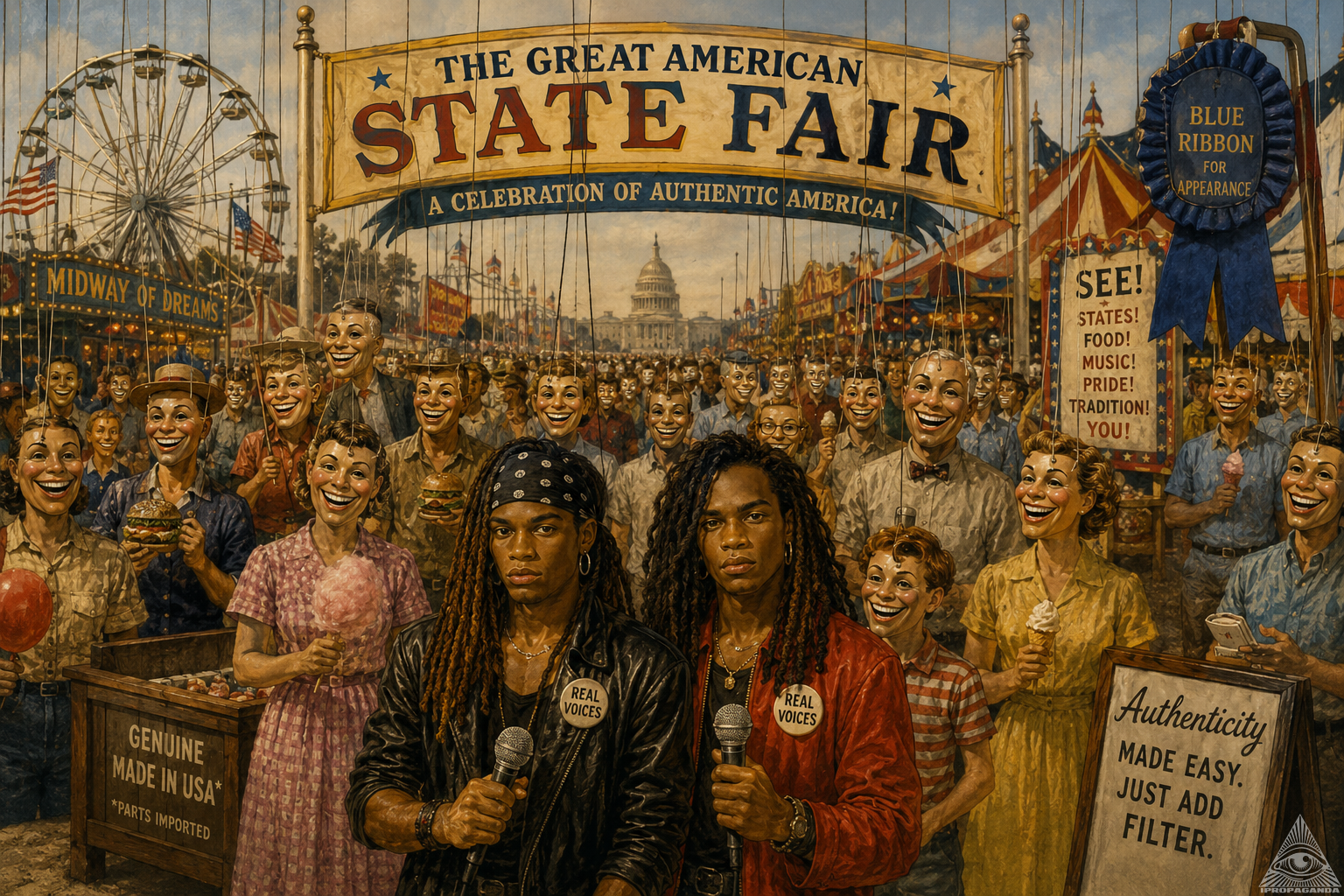
We mocked two performers for lip-syncing while building an entire culture that lets algorithms sing, write, paint, think, and remember for us. The Great American State Fair isn't celebrating authenticity—it's celebrating how completely we've confused performance with truth.
-------------------------------------------------
A state fair is supposed to be where a nation introduces itself.
You walk the midway and discover who grows the sweetest peaches, who carves the finest wood, who bakes the best pie. It is a celebration of labor made visible—a place where the ribbon goes to the person who actually raised the hog, stitched the quilt, or played the fiddle.
That's the mythology, anyway.
The Great American State Fair promises to gather every state and territory into a single national showcase—a World's Fair-scale celebration of American identity, complete with music, rides, food, and cultural exhibitions stretching across the National Mall.
It sounds like a monument to authenticity.
Which makes one detail impossible to ignore.
Among the featured acts is Milli Vanilli.
The same Milli Vanilli that American culture has spent thirty-five years ridiculing as the ultimate symbol of fakery.
The same Milli Vanilli whose name has become shorthand for "not real."
The same Milli Vanilli whose greatest crime was revealing that entertainment has always been a carefully manufactured illusion.
And somehow that makes them the perfect act for the Great American State Fair.
Because this isn't a story about two performers.
It's a story about America.
We are a country that demands authenticity while rewarding performance.
We want handcrafted values delivered by billion-dollar marketing campaigns.
We celebrate "real people" through algorithmic feeds designed to maximize engagement rather than truth.
We ask artificial intelligence to write our emails, paint our pictures, compose our music, summarize our books, and even simulate our personalities—then laugh at two men from 1989 for lip-syncing someone else's vocals.
Every day millions of Americans willingly consume synthetic voices, synthetic faces, synthetic influencers, synthetic journalism, and synthetic intimacy.
Nobody asks who actually did the work.
Nobody asks whose labor disappeared beneath the interface.
Nobody revokes awards from an algorithm.
Nobody returns the blue ribbon.
Instead we call it innovation.
Perhaps that's why Milli Vanilli refuses to disappear.
They aren't relics.
They're mirrors.
They exposed a culture that prefers the appearance of authenticity to the complicated reality of human creation.
The outrage was never about lip-syncing.
It was about breaking the illusion.
That's what makes the Great American State Fair such an unintentionally brilliant metaphor.
A fair is supposed to honor the maker.
Instead we increasingly celebrate the spectacle.
The artisan becomes invisible.
The process becomes irrelevant.
The image wins.
And so America welcomes back the duo it once publicly humiliated, not because we've forgiven them, but because we've finally caught up to them.
In 1990, we called it fraud.
In 2026, we call it artificial intelligence.
The technology changed.
The performance got better.
The audience got more comfortable.
But the show?
The show was always lip-synced.
And somewhere between the Ferris wheel and the main stage, between the deep-fried nostalgia and the patriotic branding, sits the uncomfortable truth:
Milli Vanilli didn't fake America.
America perfected the art of performing authenticity—and spent three decades blaming the opening act.