
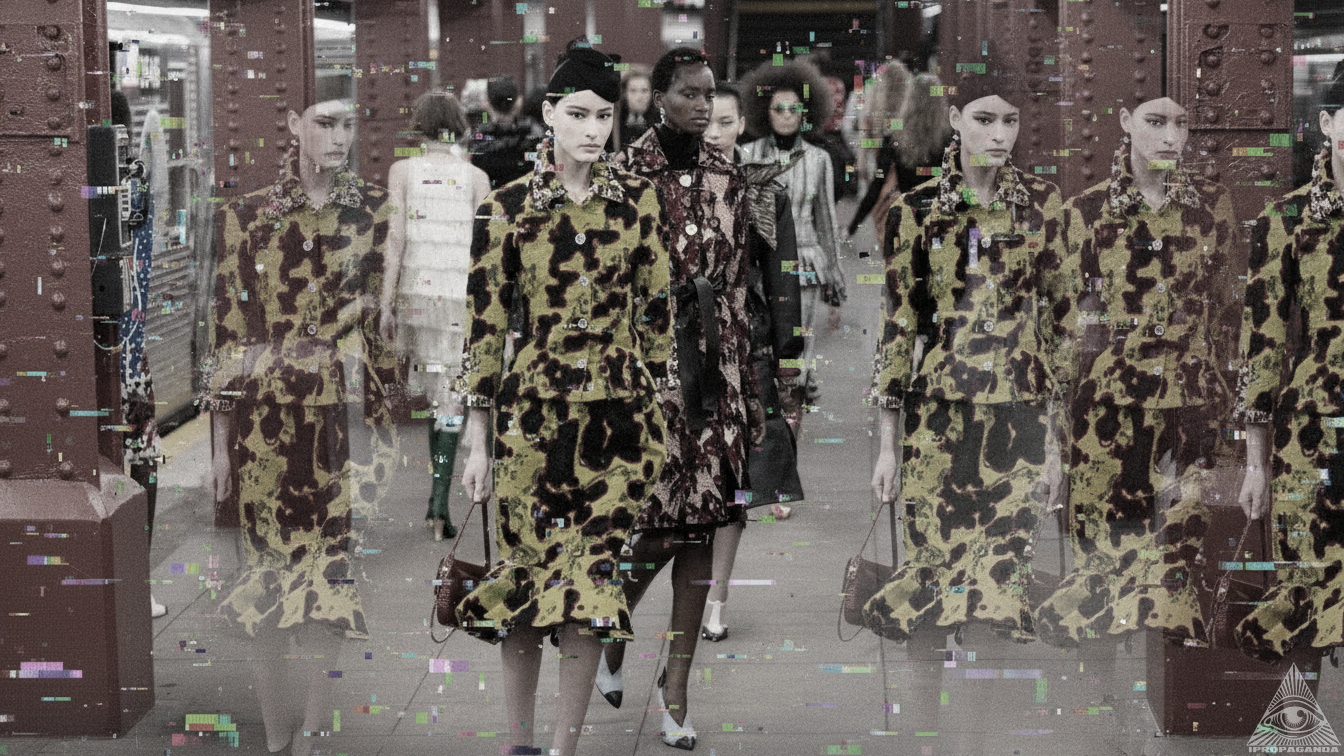
When Luxury Feasts on the Aesthetics of Struggle
Chanel’s Métiers d’Art 2026 show in a polished, sterilized, Disneyfied New York City subway station wasn’t a celebration of urban grit—it was a performance of poverty, curated for luxury consumption. It was an estimated multi-million-dollar masquerade in which one of the world’s most elite fashion house borrowed the aesthetics of struggle, stripped them of context, and repackaged them as a spectacle for the wealthy. And that is not artistic vision. That is social irresponsibility dressed in tweed.
Let’s be clear: nothing about this show reflected the reality of the subway system or the people who rely on it. The MTA is not a backlit runway for celebrities and editors. It is a survival corridor for working-class New Yorkers, undocumented laborers, students, night-shift nurses, people juggling multiple jobs, people sleeping on seats and on the stations floors because they have nowhere else to go. To turn it into a catwalk for jackets priced higher than many annual rents is not just tone deaf—it is an indictment of an industry that mines “authenticity” while actively distancing itself from the conditions that produce it.
Romanticizing Grime for Profit
Matthieu Blazy “cleaned up” the Bowery station for the show—an act that itself reveals everything. A sanitized fantasy of public transit, touched by luxury, curated for the camera. In the real world, commuter conditions are defined by a lack of resources, often crumbling infrastructure, and the human fallout of a city perpetually in crisis.
Chanel transformed everyday hardship into a costume.
It’s poverty as prop.
Urban struggle as ambiance.
Aestheticized precarity for audiences who will never feel its weight.
When The New York Times noted how the show “romanticized grime,” it was an understatement. Chanel didn’t romanticize the subway. It colonized it.
Luxury in a Lifeline
The entire concept hinges on a violent contrast: ultra-expensive garments paraded through a space where people often count change to afford fares. Chanel framed this as “accessible-feeling luxury,” proving once again that high fashion’s version of accessibility is a fantasy—something you can look at, but never touch.
To the people who spend hours underground because it's the only way to get to work, the irony is offensive.
This wasn’t a love letter to New York.
It was a love letter to the way New York looks when you strip out the people who actually live there.
The Defense: Empty, Predictable, Convenient
Of course, defenders rushed in:
“It’s artistic!”
Yes—so is every project that exoticizes marginalized spaces without acknowledging the politics of occupying them.
“It shows real characters of New York.”
A few hand-selected archetypes—journalists, tourists, businesswomen—chosen by stylists is not representation. It’s costume play.
“It celebrates the city.”
Celebration without accountability is not celebration. It is exploitation.
The Cut’s comment about “capturing fleeting caught moments” only underscores the problem: the city’s most vulnerable moments are not aesthetic opportunities. They are lived experiences that demand investment, not imitation.
The Real Violence: Displacement Through Spectacle
What Chanel staged was not a fashion show. It was a demonstration of power. A reminder that even the spaces working-class people rely on can be temporarily commandeered and transformed into a luxury playground. Chanel didn’t break the system, as some claimed—it flaunted its ability to manipulate and repackage it.
You know what would actually “break the system”?
Funding public transit.
Honoring the people who keep it functioning.
Understanding that the subway is not a backdrop—it is a lifeline.
Instead, Chanel gave us a fantasy: a gleaming stage powered by the labor of people who will never wear what walked across it.
This Is the New Aesthetic Colonialism
What happened at Bowery Station this week is a symptom of a larger cultural disease: elite institutions cherry-picking from working-class environments, stripping away context, then selling the result back to themselves as “edgy.” It is aesthetic extraction. Culture-mining. Gentrification in couture form.
Fashion wants the visuals of reality without the accountability that comes with acknowledging it. Chanel wants the New York subway without its riders. Wants “grit” without grime. Wants “authenticity” without people.
In a world burning with inequality, displacement, and economic violence, Chanel delivered a show that was stunningly beautiful—and stunningly blind.