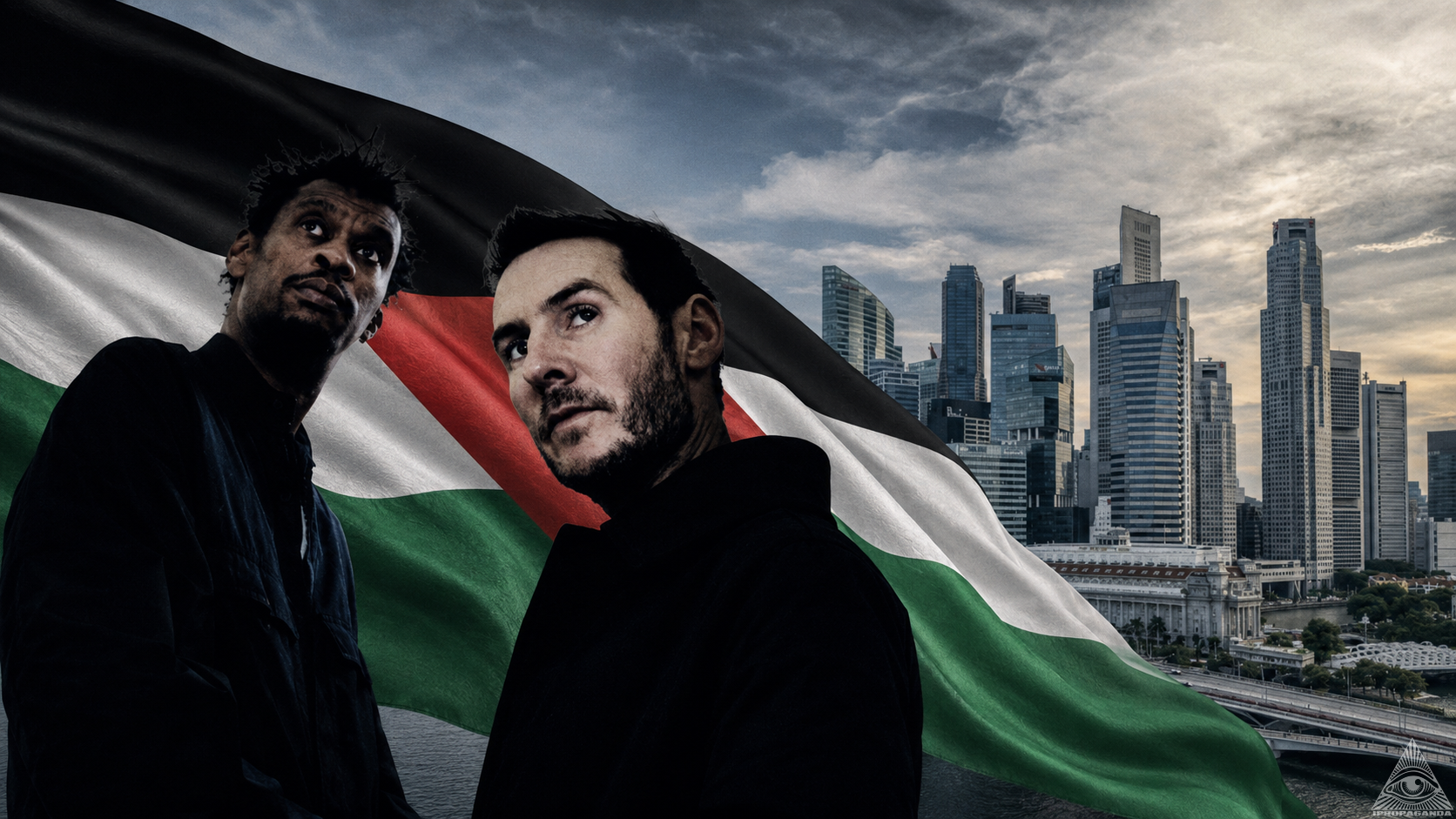
Singapore’s decision to detain, interrogate and ban Massive Attack for displaying a Palestinian flag was more than an excessive response—it was a warning against public conscience. When a government treats peaceful solidarity as a threat to social order, “harmony” becomes little more than censorship dressed in bureaucratic language.
Singapore did not protect public harmony by banning Massive Attack. It punished political conscience—and the details now emerging make the government’s response appear even more authoritarian.
During the group’s July 29 concert, two members reportedly unfurled a Palestinian flag while one called out, “Free Palestine.” Singapore responded by issuing warnings, permanently barring the two musicians from re-entering the country and declaring that Massive Attack would never again receive permission to perform there.
But the punishment did not end at the stage door.
According to Massive Attack, the entire touring party was detained by police, isolated and questioned separately. Some members reportedly had their hotel rooms searched, while their passports were temporarily confiscated. The band described the experience as surreal, saying it had not imagined that displaying the flag of Palestine—a state recognized by 157 countries—would be treated as a criminal act. The Guardian
Let us be clear: a Palestinian flag is not an act of violence. It is not hate speech. It is not a weapon. It is the national symbol of a people whose existence, displacement and right to self-determination remain at the center of one of the defining moral crises of our time.
Singapore’s insistence that such expression threatens “racial and religious harmony” turns harmony into a euphemism for obedience. Real social cohesion is not produced by detaining artists, searching hotel rooms or confiscating passports because an audience expressed solidarity with an oppressed people. It is not preserved by making political feeling disappear.
It is produced by allowing difficult truths to be confronted without treating solidarity as sedition.
Singapore may argue that its restrictions apply to all foreign flags. But equal enforcement does not automatically make an unjust restriction defensible. A law can be neutral on paper while becoming morally grotesque in practice. Context matters. Proportionality matters. The difference between inciting hostility and expressing support for Palestinian freedom matters.
No violence occurred. No threat was made. Indeed, Massive Attack said the chants of “Free Palestine” emerged organically from the audience. That detail is important because it disrupts the government’s attempt to portray political expression as something foreign artists imported into an otherwise passive society.
The audience was not manipulated into responding. It recognized the symbol and answered it.
What Singapore punished, therefore, was not simply the conduct of two visiting musicians. It punished the public visibility of sentiments already present among people inside Singapore.
The government’s language about preventing the importation of “foreign politics” is especially dishonest in an interconnected world. Singapore is a global financial center, an international concert destination and a state deeply embedded in global trade, diplomacy and culture. It cannot eagerly import foreign capital, foreign entertainment and foreign prestige while declaring foreign conscience inadmissible.
Apparently, everything may cross the border except solidarity.
The severity of the response reveals the real objective. This was not merely about enforcing a permit requirement. If it were, a fine or formal warning would have sufficed. Detaining the entire touring party, separating its members for questioning, searching private rooms, withholding passports and permanently excluding the musicians constitutes political intimidation.
The message extends far beyond Massive Attack: artists may enter Singapore, entertain its audiences and contribute to its economy—but they must leave their convictions at the border.
That demand fundamentally misunderstands what art is.
Massive Attack’s political engagement is not an accessory that can be removed when inconvenient. Their work has long connected sound, war, surveillance, displacement and state power. Inviting politically engaged artists while prohibiting political expression is an attempt to purchase the aesthetics of dissent after stripping away its substance.
Singapore wants the performance, but not the conscience behind it.
The contradiction becomes sharper because Singapore itself has supported Palestinian statehood in international forums. Yet on a public stage, the mere display of the Palestinian flag becomes intolerable. The state is comfortable discussing Palestinian rights as carefully controlled diplomatic language—but not allowing those rights to become a living cultural demand.
This is how censorship increasingly operates. It rarely announces itself by saying, “We oppose justice.” Instead, it speaks of licensing conditions, foreign influence, public order and social sensitivity. Bureaucratic language sanitizes political repression. The paperwork appears neutral while the consequence remains unmistakable: Palestine may be discussed abstractly, but solidarity with Palestinians must not become public, emotional or contagious.
A government statement can be managed. A flag raised before a cheering crowd cannot.
That is precisely why Singapore reacted so aggressively. The moment demonstrated that public feeling exists outside the state’s approved vocabulary—and that music can create a temporary space in which people say aloud what governments would prefer to keep administratively contained.
Massive Attack has correctly identified the broader warning. The incident is not merely about one band, one flag or one country. It concerns the continuing erosion of the right to political expression whenever that expression challenges governments, commercial institutions or dominant geopolitical interests. The band has also urged Singapore to ratify the International Covenant on Civil and Political Rights, which protects freedom of expression and peaceful assembly.
Banning Massive Attack does nothing to resolve tensions surrounding Gaza or protect Singapore’s communities. It merely teaches citizens and visiting artists that some human suffering must remain publicly unacknowledged. It transforms Palestinian visibility into a punishable disruption and silence into the price of cultural access.
That is not neutrality.
Neutrality would mean refusing to discriminate between people’s humanity. Silence imposed by the state is something else entirely: political alignment disguised as public order.
Singapore had an opportunity to demonstrate that a confident society could withstand a flag, a phrase and an artist’s conscience. Instead, it showed the world how quickly administrative control can become moral cowardice.
The Palestinian flag did not threaten Singapore.
The cheering audience did not threaten Singapore.
What threatened Singapore was the realization that, even under strict control, people can still recognize injustice—and answer it together.