
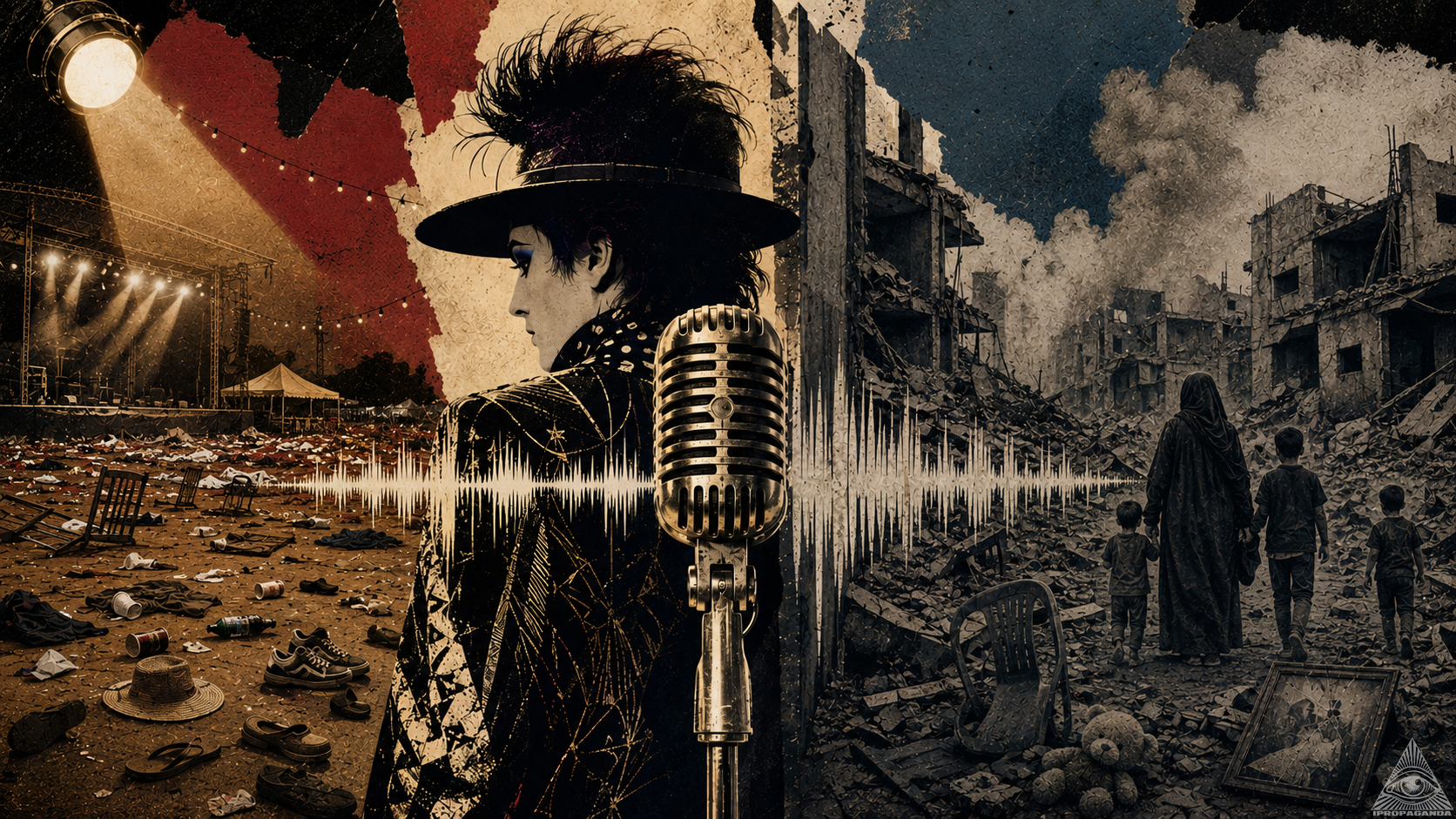
Boy George’s new song, “We Will Dance Again,” wants to present itself as an anthem of human solidarity. Instead, it demonstrates how easily solidarity becomes propaganda when compassion is granted to one population by erasing another.
The song begins with a neat rhetorical exchange: “You say genocide, I say war.” But genocide and war are not competing musical preferences. One is a legal and moral accusation about what can be done to a people under the cover of the other.
Boy George recalls the horror of October 7—the murder of civilians at the Nova music festival, the hostages taken and the brutality inflicted. Those lives should be remembered. That trauma should never be trivialized. But remembrance becomes politically dangerous when it is used to place everything that followed beyond moral examination.
More than 73,000 Palestinians have reportedly been killed since the war began. Most of Gaza’s population has been displaced. Homes, hospitals and essential infrastructure have been destroyed, while access to food, water and humanitarian assistance has been severely restricted. Independent UN inquiries have concluded that Israel has committed genocide in Gaza—findings Israel rejects. Against that reality, “You say genocide, I say war” does not sound like thoughtful disagreement. It sounds like a refusal to look. The Independent
The song also accuses musicians carrying Palestinian flags of “selective memory.” Yet selective memory is precisely its operating principle. It remembers Israeli victims and largely removes Palestinian victims from the frame. It invokes the humanity of Jewish people while confusing that humanity with the actions of the Israeli state. It describes one population’s terror in intimate, emotional language and reduces the destruction of another to war getting “ugly.”
This distinction matters: Jewish people are not the Israeli government, and criticism of Israel’s military conduct is not inherently condemnation of Jews. To collapse those categories does not protect Jewish communities from antisemitism. It turns their identity into political cover for a state’s actions.
There is also an unavoidable contradiction in hearing this from Boy George. In 1984, Culture Club released “The War Song,” an exuberant anti-war record built around the declaration that war is stupid. Four decades later, war is presented as ugly but necessary—its devastation absorbed into a reggae-pop rhythm and a chorus of resilience. The artist who once treated war itself as moral failure now treats the word “war” as a defense against the accusation of genocide. The Guardian
None of this means Boy George must abandon his Jewish friends or suppress his horror over October 7. That is another false choice embedded in the song. Supporting Jewish people does not require abandoning Palestinians. Condemning Hamas does not require endorsing collective punishment. Mourning the victims at Nova does not require silence about children killed in Gaza.
Perhaps the most revealing lyric is not “I stand with the Jews,” but Boy George’s claim that doing so means behaving “like a human.” The question is not whether Jewish lives deserve that humanity. They unquestionably do. The question is why the song cannot extend the same moral recognition to Palestinians.
Music can preserve memory, challenge power and help people survive what politics has done to them. But music can also simplify violence until atrocity becomes a matter of perspective and empathy becomes a loyalty test.
“We Will Dance Again” presents itself as a song against hatred. What it reveals instead is the danger of compassion with borders.