

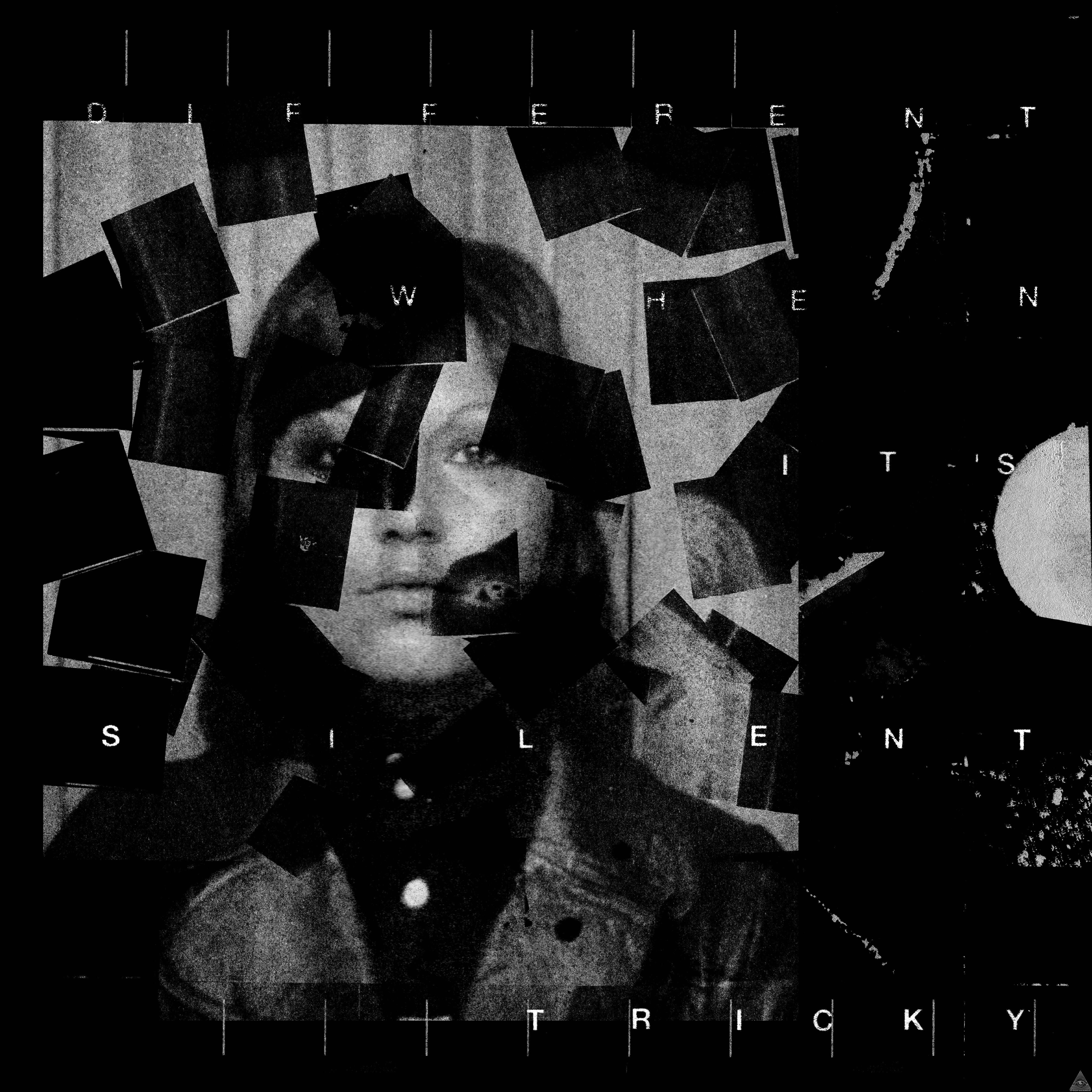
Grief, Guitars and a Voice Emerging From the Shadows
Release date: 17 July 2026
Label: False Idols
Standout tracks: “I Still See Me There,” “I’m Yours,” “Be Still in the Pain,” “Piano,” “Out of Place”
Rating: 8/10
Few artists have made darkness sound as physical as Tricky. Since Maxinquaye transformed British music in 1995, Adrian Thaws has built records from whispered voices, suffocating basslines and rhythms that appear to move through fog. On Different When It’s Silent, that darkness remains, but its shape has changed.
Released through Tricky’s own False Idols label, the 14-track album is his fifteenth studio record and his first full-length under the Tricky name since 2020’s Fall to Pieces. He was hardly inactive during those six years: projects including Lonely Guest, Theis Thaws and his work with Marta Złakowska kept him creating, often without the promotional attention attached to a conventional solo release. Different When It’s Silent was recorded between France and Bristol and was originally imagined as another side project before manager Alan McGee persuaded him that the material belonged on a Tricky album.
The resulting record does not attempt to recreate Maxinquaye. Instead, it reconnects with the instincts behind Tricky’s best music: tension, emotional ambiguity and the collision of voices that appear to occupy different psychological worlds.
A Record Shaped by Absence
The album arrives with an unavoidable emotional context. Following the sudden death of his daughter in 2019, Tricky has spoken about throwing himself into work while becoming increasingly uncomfortable with publicity and life in the foreground. He has described Fall to Pieces as the immediate expression of being emotionally shattered; the records that followed allowed him to work more privately and support other artists.
Different When It’s Silent does not present grief as something neatly resolved. It is filled with uncertainty, repetition and emotional after-images. Its songs frequently sound caught between holding on and moving forward.
Yet this is not simply a bleak album. There is also movement here—a sense that making the record has allowed Tricky to re-enter his own artistic life. He has said the album represents a readiness to begin living, recording and touring with renewed purpose after feeling emotionally paralysed.
That transition gives the music its power. Pain is present, but so are momentum, curiosity and the familiar Tricky impulse to wreck the boundaries between genres.
Beyond Trip-Hop
Calling Different When It’s Silent a trip-hop album would be convenient, but not particularly accurate. Tricky’s music helped define that label in the 1990s, although he has spent much of his career pushing against it. Here, the familiar low-end pressure and nocturnal atmosphere are joined by live drums, electric guitars, strings, organ, piano and flashes of industrial and post-punk abrasion.
The first half is especially guitar-driven. “I Tried” surrounds its vocals with droning electronics and heavy distortion, while “Paris Maybe” drifts into shadowy dream-rock. “Cannon Fodder” begins with an almost religious organ tone before a distorted guitar tears through its restraint. Elsewhere, “So Cold” introduces a sharper dance-rock pulse, and “Radana” turns toward bass-heavy grime.
These stylistic shifts can make the album uneven, but they also prevent it from becoming a museum piece. Tricky is not polishing the sound of his past for nostalgic consumption. He is placing his methods—contrast, repetition, distortion and vocal dislocation—inside a more organic rock framework.
Mitch Sanders Steps Forward
The album’s defining collaborator is Bristol vocalist Mitch Sanders, whose high, clear falsetto appears on most of the record. His voice is the opposite of Tricky’s compressed rasp: Sanders sounds exposed and weightless, while Tricky often seems to be speaking from behind a wall.
That contrast can be compelling. On “I Still See Me There,” Sanders carries the melody while Tricky’s murmured presence moves underneath it like an intrusive thought. “I’m Yours” transforms their contrasting voices into something less like a duet and more like a struggle between vulnerability and possession. On “Hengrove Blues,” Sanders is left almost entirely exposed against a stripped-down arrangement.
There is, however, a legitimate criticism to be made: Tricky sometimes recedes too far into his own album. Sanders is a distinctive and versatile singer, but listeners expecting Tricky’s voice to dominate may find themselves waiting for him to take control. Some critics have viewed that imbalance as the record’s central weakness.
The restraint appears deliberate. Tricky has always treated voices as materials rather than arranging every song around his own performance. Sanders is not merely a featured singer; he becomes a vessel through which Tricky can express emotions that his own voice might render too familiar or too guarded.
That decision pays off when Tricky finally moves decisively into the foreground on the closing “Out of Place.” His reappearance carries far more force because the album has spent so long withholding it.
The Standout Songs
“I Still See Me There”
The opener immediately establishes the album’s emotional and musical language. A slow, funereal rhythm is joined by pitched-down bass, skeletal percussion and Sanders’ falsetto, while Tricky’s whispering operates as an uneasy internal commentary.
The track does not explode or offer an obvious release. Instead, it circles its central feeling, suggesting that memory is not passive: it is a place the mind repeatedly returns to. Its unusual, crawling rhythm also makes the song feel unstable, as though every step forward risks collapsing.
“I’m Yours”
“I’m Yours” is more immediate, but no less threatening. Tight drums, damaged synth textures, strings and sudden guitar weight turn its apparent language of devotion into something claustrophobic.
Tricky and Sanders sound less like two people harmonising than two competing interpretations of the same relationship. Sanders supplies tenderness; Tricky introduces doubt, menace and emotional friction. The result is one of the album’s most accessible songs without sacrificing its unease.
“Be Still in the Pain”
The third track brings hip-hop more clearly into the record. A muscular bassline and energetic drums sit beneath strings and Sanders’ floating vocal, while Run Red Rambo contributes a hard-edged guest verse.
What makes the track work is the disagreement between its parts. The beat pushes ahead, the strings suggest drama, and the vocals appear emotionally suspended. Rather than treating pain as stillness, the arrangement makes it restless and almost physical.
“Paris Maybe”
“Paris Maybe” is among the album’s most effective departures. Its combination of melodic guitar, melancholy atmosphere and Sanders’ dramatic vocal places it closer to dream-rock or post-punk than conventional trip-hop.
There is a romantic sweep to the music, but Tricky keeps damaging its surfaces. The production never becomes fully lush or comforting; beauty is repeatedly interrupted by tension. That balance makes it one of the record’s strongest examples of Tricky moving beyond his established vocabulary.
“Piano”
One of the quietest songs becomes one of the most affecting. “Piano” is constructed around a looping keyboard figure, Sanders’ falsetto and operatic vocals from Samantha Rowe. The arrangement is spacious enough that every vocal movement seems magnified.
Where other tracks rely on distortion, “Piano” finds intensity through absence. Its restraint brings the album’s title into focus: silence here is not emptiness, but a space in which small sounds acquire enormous emotional weight.
“Out of Place”
The finale reunites Tricky with longtime collaborator Marta Złakowska and provides the record with its most forceful conclusion. Distorted guitar, synthesiser, strings and the album’s fastest beat create a dense, surging backdrop.
More importantly, Tricky finally stops haunting the edges of the mix. His delivery becomes fuller and more confrontational, while Marta’s low, controlled vocal provides a steady counterweight. It feels like the moment when the record’s submerged emotions finally reach the surface.
It is both an ending and a reintroduction: the familiar Tricky voice returns, but it has been changed by everything preceding it.
Where the Album Loses Focus
The second half is more exploratory, but not every experiment carries the same emotional weight.
“Marinade,” Tricky’s reworking of the Dope Lemon song, replaces the original’s looseness with clipped strings and a programmed beat. It is an intriguing transformation, complete with substantially rewritten lyrics, but it feels more like an exercise in reconstruction than an essential chapter in the album’s emotional journey.
The 99-second “Frontier Town” is an even stranger interruption. Its processed vocals and exaggerated Americana stomp are deliberately artificial, yet the track arrives without enough time to develop its idea. It provides contrast, but also breaks the spell created by the surrounding songs.
“Hengrove Blues” is similarly stripped back, though its fragile acoustic character is likely to divide listeners. For some, its two-chord simplicity will feel unfinished. For others, including Apple Music’s editors, its lo-fi singer-songwriter approach is one of the album’s most effective moments.
These weaker or more divisive tracks do not ruin the album. They reveal an artist who would still rather risk an awkward turn than settle into a perfectly consistent formula.
Verdict
Different When It’s Silent is not a return to the 1990s, even when echoes of Tricky’s earlier work pass through it. Its guitars, live drums and male-led vocals give the record a distinct identity, while its most affecting moments come from the gap between Mitch Sanders’ exposed falsetto and Tricky’s guarded, weathered presence.
The album is imperfect. Its second half occasionally wanders, and Tricky’s decision to remain in the background can be frustrating. Yet that absence is also central to the record’s meaning. This is music about being present while feeling removed from yourself—about recognising your own outline in memories, collaborators and sounds.
When Tricky finally steps forward on “Out of Place,” it does not feel like a nostalgic return. It feels earned.
More than three decades after Maxinquaye, Tricky remains difficult to classify and impossible to comfortably imitate. Different When It’s Silent proves that his music does not need to be louder to feel overwhelming. At its best, it turns restraint into pressure, collaboration into psychological drama and silence into something that speaks.